
What High-Volume Furniture Lines Need from a Panel Mill
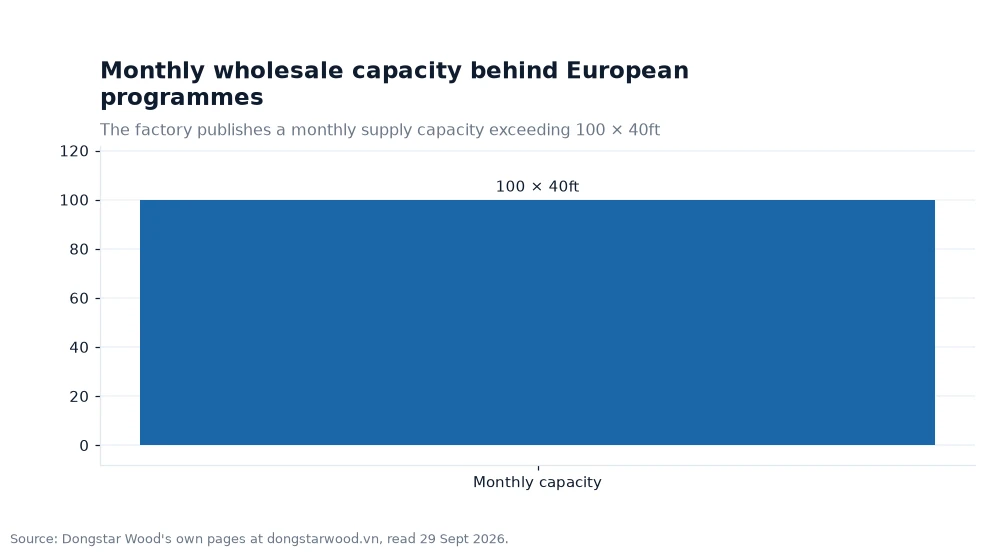
Daily furniture lines need a panel supply that keeps pace. Dongstar Wood publishes a monthly supply capacity exceeding 100 × 40ft, lists No Anti-Dumping Tax among its European selling points, and positions itself as a Vietnam plywood manufacturer focused on furniture plywood, hardwood plywood and veneer plywood with OEM and custom solutions.

Key takeaways
- Thickness bands do the mapping: 6–9 mm for backs and partitions, 12–15 mm for fixtures, 18 mm for heavy-duty panels.
- Face and core are specification levers: Birch, Pine, Bleached Poplar, EV and Rose Eucalyptus faces over Acacia, Bodhi, Eucalyptus or Combi cores.
- Glue class matches the environment: MR for dry interiors, BWR for humidity and light water exposure.
- The duty position is part of the offer: No Anti-Dumping Tax for the EU market.
Thickness bands that map to furniture parts
A piece of furniture combines parts with different jobs, and the mill's own guidance sorts them by thickness. Drawer bottoms, cabinet backs and partitions take 6–9 mm; fixtures, shelves and hotel furniture sit at 12–15 mm; structural panels, worktops and heavy-duty pieces require 18 mm. Contractors often standardise 12 mm and 18 mm across a programme.
For a high-volume line, that guidance is a planning tool rather than a catalogue. A buyer who fixes the thickness of each part before the first quote removes the most common cause of line stoppage: a panel that arrives too thick for the fitting or too thin for the joint. The published bands make the conversation about parts, not about panels. The bands also interact with the size window: a programme cutting 1250 × 2500 mm sheets at 12 mm for fixtures and 18 mm for worktops gives the factory two stable line settings, and stable settings are what keep a monthly rhythm intact.
Face veneers and cores as specification levers
The face is what the end user sees and the core is what the machinist feels. The manufacturer's Commercial Plywood page offers Birch, Pine, Bleached Poplar, EV and Rose Eucalyptus face veneers, over Acacia, Bodhi, Eucalyptus or Combi cores. Each combination answers a different question: appearance, machinability, weight or cost.
A high-volume line standardises the answer. Once a face and core combination has proven itself on the line, the buyer's job is to keep it available — which means telling the mill the combination, not just the panel name. The client's own description of its offering runs to furniture plywood, hardwood plywood and veneer plywood, and those three words cover most of the combinations a furniture programme will ever need.
Glue classes for the room, not the panel
Glue is chosen for the environment the furniture will live in, and the mill's guidance is explicit: MR (Moisture Resistant) glue for dry interiors, BWR (Boiling Water Resistant) glue for humidity and light water exposure. A kitchen programme and an office programme are not the same purchase, even when the panels look identical.
The distinction matters most at volume, because a glue class is a line setting, not a label. Changing it means changing the press cycle, so a buyer who fixes the glue class with the thickness keeps the factory's schedule stable — and a stable schedule is what a monthly programme actually is.
The six reasons the mill lists for EU customers
The six reasons the mill lists for buying from this origin are: stable monthly supply, more affordable and cost-effective supply than Chinese factories, strong QC at every production stage, custom core structure and size, glue, face veneer and grade, competitive pricing for European wholesale distribution, and adaptable MOQ with fast delivery to Europe.
Read as a buyer, those six reasons are six promises about the same thing: predictability. A high-volume furniture line does not need a supplier that is occasionally brilliant; it needs one that is consistently adequate, container after container. The published reasons are worth testing against that standard rather than accepting as marketing. The reasons are published, which makes them testable: a buyer can ask for the monthly supply figure behind the stable-supply promise, the QC records behind the quality promise, and the custom-size examples behind the flexibility promise. A mill that answers with documents rather than adjectives is a mill whose rhythm can be planned against.
OEM and custom solutions at production volume
Volume does not have to mean standard. The mill describes OEM and custom plywood solutions alongside its standard ranges, and the custom levers are the same ones a buyer already controls: size, core structure, glue, face veneer and grade. A line running 12 mm and 18 mm panels can still ask for a specific face veneer on one of them.
The practical step is to write the custom requirement into the programme plan rather than into a one-off email. A custom size inside a monthly rhythm is a line setting the factory can schedule; a custom size that arrives as a surprise is a line stoppage wearing a different hat. The custom conversation starts from the same specification sheet as the standard one: size, core structure, glue, face veneer and grade are the five levers, and a buyer who has already fixed them for the standard programme can move one lever at a time — the disciplined way to customise without breaking the schedule.
| Furniture part | Published thickness | Glue guidance |
|---|---|---|
| Cabinet backs, drawer bottoms, partitions | 6–9 mm | MR for dry interiors |
| Office furniture, shelves, hotel fixtures | 12–15 mm | MR for dry interiors |
| Heavy-duty furniture, worktops, structural panels | 18 mm | BWR where humidity is present |
| Standardised programme sizes | 12 mm and 18 mm | Fixed per part, not per order |
Worked example: capacity against a furniture programme
Turn the published capacity into a furniture programme. A 1250 × 2500 mm sheet delivers 1.25 m × 2.5 m, totalling 3.125 m², and a line consuming 40 m² a day draws 40 ÷ 3.125 ≈ 13 sheets a day. Against a monthly rhythm of 100 × 40ft ÷ 4 weeks = 25 containers per week, a single furniture line is a manageable share of output — the kind of order a factory can hold steady across a quarter.
Frequently asked questions
Which thickness should a furniture programme standardise on?
Contractors often standardise 12 mm and 18 mm: 12 mm for office furniture, shelves and hotel fixtures, 18 mm for heavy-duty furniture, worktops and structural panels. Fixing those two thicknesses removes most of the variation a high-volume line has to absorb.
How do MR and BWR glue grades differ?
MR (Moisture Resistant) glue suits dry interiors, while BWR (Boiling Water Resistant) glue suits humidity and light water exposure. The glue class is a line setting, so it should be fixed with the thickness before the programme starts.
What does the No Anti-Dumping Tax position mean for EU buyers?
Dongstar Wood confirms 0% anti-dumping duties for its European and US shipments, and the No Anti-Dumping Tax position is part of the published offer for the EU market. It belongs in the landed-cost calculation, written alongside the Incoterm.
Specifying the programme, not just the panel
A high-volume line is specified part by part, and the mill's published bands give you the vocabulary. Read the company's own profile to verify the operation behind the offer, then look at the birch ranges to see how a single face veneer can carry several thickness bands in one programme. The lines that run smoothly are the ones whose buyers did that reading before the first container.
The measurements discussed were obtained from the vendor's online documentation as read on 29 Sept 2026[1].